|
Mountaineering
- High altitude. Moderate climbing following the normal route or northern
face.
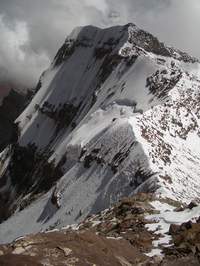
Aconcagua is the roof of America and the highest peak in the world
outside the Himalayas, it's also the easiest option to climb an almost
a 7000m peak, been technical easy, you mostly need endurance, a good
team work and a good plan to handle acclimatization as well mountain
conditions, to maximizes your chances of reach the top; and that's
exactly what we offer, having been in and around that mountain since
1984, we really know it, so we are sure to offer you the appropriated
strategy at the right time to succeed.
Is important to keep in mind that in this kind of peaks, the success
key is how you preserve your physical and mental energy, so we will
worry about the summit at the appropriated time but not before. As
an example, in the approaching days we need to focus into get, in
good conditions, to the BC, keeping in mind the joy of walk, using
the time to learn some about the place, the history, the legends and
ourselves, having of course time for photos, then at the BC we need
to resolve and have a good logistic for the days at upper camps and
then, of course, we need a plan for the summit day.
|
|
| DAY 1 MENDOZA |
| Meeting
day at the airport, after we drop our equipment in the hotel, we go
get the permit at the Aconcagua Park Offices which stay in a big park,
full of 100 years or more old trees, from where we could walk back
to downtown Mendoza, enjoying this vibrating town, gear check and
free time. Hotel (Today the lunch and dinner are on your own.) |
| DAY 2 MENDOZA
- PUENTE DEL INCA - CONFLUENCIA (3200M) |
| After breakfast
we leave Mendoza, using a paved route that in 3 hours, lead us to
the heart of the Andes and just arriving to the Argentinean side of
the border we deviate to reach the Hormones valley. The car will leave
us at the Park Rangers station, where we sign in and show the permit,
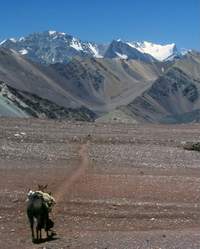
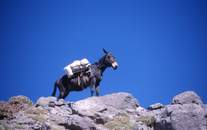
from here we will walk, only with a day pack us our gear is been carrying
up to Plaza de Mules with mules. It's a 3-4 hours walk up to Confluencia,
call this way as two major rivers, one coming down the south face
and the other from the north " normal " route meet. The
paths cross diverse, but mostly semi-arid terrain were we could see
and hear deferent types of birds all the way up. We set up camp at
Confluencia camp ground, where we have fresh water, rest and dinner
Camp (B, L, D) |
| DAY 3 CONFLUENCIA |
| Today is
an active rest day, after breakfast we hike up the South face valley,
to take a look at this one of the biggest wall in the world, been
almost 3k tall and over 8k wide, with several glaciers hanging over
the foot of the wall. We will hear some of the many epic stories,
this wall have to tell. Is 5 to 6 hours round trip, then back to camp
we hydrated and rest Camp (B, L, D) |
| DAY 4 CONFLUENCIA
- PLAZA DE MULAS (4300 M) |
| Early morning
start as a way to avoid the midday heat, today is a long day, taking
no less than 7 hours reach Plaza de Mules, which is the base camp.
The hike goes over mix terrain, sometimes we follow a path and many
times we open the trail, as the river bed we are walking on, is always
changing, it's a hard day as we not only get into more dry and windy
terrain but also we gain altitude. Arriving to BC we show the rangers
our climbing permit to then arrange our camp. Rest Camp (B, L, D) |
| DAY 5 REST
DAY AT PLAZA DE MULAS |
| No hurries
today, as we need to keep acclimatizing and do not wear out our energies,
so we have a relax breakfast and then we will use some part of the
day to arrange the gear, the equipment, the food and the gas. Also
as in the BC there are people from all around the world, it's nice
to have time to socialize or to visit different areas of this sometimes
quite huge place, or simply just rest Camp. (B, L, D) |
| DAY 6 CERRO
BONETE (5000M) CLIMB |
| Bonete
ascent will provide us with a good approach to altitude, as well with
an amazing front view of Aconcagua normal route, our route, as Bonete
sit just across the valley. 5 hours round trip, camp, hydrated, rest
Camp. (B, L, D) |
| DAY 7 PLAZA
DE MULAS - CAMP I (5300M) - PLAZA DE MULAS |
| Another
day at work, we carry part of our gear and food and gas, as a way
to made our packs lighter, also, we will reach the 5300m, so far our
highest point, so is a good time to check ourselves about how are
we getting acclimatizing. At Nido de Condores we choose our future
campsite, we hide the stuff we had carried to then return to BC. It's
about 4-5 hours up and 1-2 hours down. Camp. (B, L, D) |
| DAY 8 PLAZA
DE MULAS |
| Today's
is a multiple options day, we could rest at the BC or if every body
is feeling fine and in form, we could move to camp I, this will give
us one more extra day, in case we need it before try the summit. If
we stay at Plaza de Mulas, we rest and prepare all for the next day.
Camp. (B, L, D) |
| DAY 9 PLAZA
DE MULAS - NIDO DE CONDORES (CAMP I, 5300M) |
| Today is
the day we are going up, packs gone to be check, to don't carry anything
superfluous but still they will be heavy, but we have time. Soon as
we arrive to Nido de Condores, we put up the tents and start to melt
snow to made water. Rest, dinner, and before go bed a look to the
thousands start over ours heads Camp (B, L, D) |
| DAY 10 CAMP
I - PIEDRAS BLANCAS (CAMP II, 5900M) |
| After breakfast
and that the sun warm us up, we dismantle the camp, pack everything
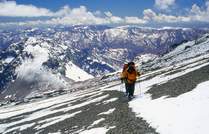
we will need and move to the next camp which is 2 hours away, we hike
is following a pretty good if sometimes slippery, or maybe cover with
snow trail. As soon as we arrive we set up the tents, and start the
water process, we could also enjoy a magnificent view almost above
every other mountain close to us. We rest hydrate and prepare ourselves
and the gear for tomorrow morning. Camp (B, L, D) |
| DAY 11 CAMP
II - SUMMIT - CAMP II |
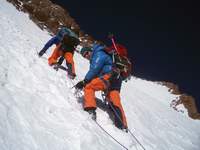
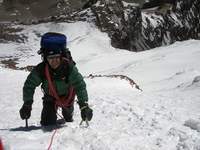
| Early breakfast
and early departure at around 5:30, we don't need go earlier as we
could get too cold, so starting at this time it will made us hit Independencia
old semi-destroy hut just when the first sun rays are warming the
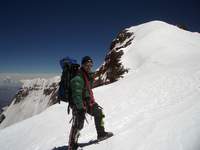
place, from here it's 4 to 5 hours more to the summit, the terrain
could be or not cover with snow, but we will carry our crampons as
you never know. On the way up most probably there gone to be other
teams, but we will keep a group rhythm to reach the top all together,
safe, tire but happy, to enjoy the amazing 360º view. If weather
is good we could stay longer on the top and look down to the south
face, the polish glacier and BC far, far down. We back to have a good
rest and a hot meal to camp II in about 3 hours. Camp (B, L, D) |
| DAY 12-13
RESERVE DAY |
| As the
second day at Plaza de Mulas, this extra day is just in case we have
bad weather or we need, for whatever reason some more time. Strategy
is the key to success in such high altitude peaks, so, of course if
every body is feeling and going fine and the weather looks ok, we
just will go for the summit the first day, but sometime the wind is
too strong or too cold so is always good and relaxing to know that
we could count on some extra opportunities days Camp (B, L, D) |
| DAY 14 CAMP
II - PLAZA DE MULAS |
| After
breakfast, we dismantle the camp, pack everything including the thrash,
and we go down to BC, and were we arrive to celebrate in about 3 hours.
Is a hard day as our packs are heavy and we are tire from summit day
effort, anyhow at BC lunch is waiting, then rest and prepares tomorrow
mules packs. Dinner Camp (B, L, D) |
| DAY 15 PLAZA
DE MULAS - PUENTE DEL INCA |
| We leave
BC just after breakfast, as we need between 7 to 9 hours to get back
to the road head. It's a long route, but always quite calm as relax
in the sense that we know the way, we are going down after a good
job, so is amazing how much warm, and know looks everything, at the
ranger station we show the permits, then we ride the car for 5 minutes
to the near by hotel. Rest, dinner Hotel (B, L) |
| DAY 16 PUENTE
DEL INCA - MENDOZA |
| Drive back
to Mendoza and transfer to the hotel Hotel. (B) (lunch on your own.) |
| DAY 17 MENDOZA
- FAREWELL |
| Breakfast.
End of services. |
| |
| Season:
November 25th to March 5th. |
| Participant:
Min. 2 - Max. 12 |
| |
|
|
|
November 25
|
December 9 & 22
|
January 6 & 20
|
|
February 17
|
March 3
|
|
|
|
|
|
|
|
Min. 4 Persons
|
US$ 2238
|
|
Single supplement
|
US$ 125
|
|
| |
|
INCLUDED :
- Organization, logistic and support during the whole ascent
- Private transportation Mendoza - Horcones - Penitentes - Mendoza
- Professional Bilingual private Mountain Guide (ratio mountain
guides/clients: 1/3) .
- Mules for the luggage on days 2 and 15, with a maximum of 25
kg.
- Meals as mention in the program.
- High quality community camping and mountain gear, including
tents in double accommodation, full base camp structures and services
(Such as Mess Tent, Toilettes, stoves ,cooking year etc.)
- Two nights at the hotel (4*) at Mendoza and one night at Hostería
Puente del Inca or similar.
- Radio Communication VHF .
- First aid kit, including pulse oximeter
|
|
NOT INCLUDED :
- Aconcagua Permit Fee.
- Personal gear & equipment (mattress, sleeping bag and others).
- Any kind of insurance.
- Meals in Mendoza and Dinner at Puente del Inca or Penitentes.
- Any extra cost for early departure.
- Porters (may be hired at Plaza de Mulas).
- Tips.
- Any cost not mentioned in the program.
- Medical expenses.
- Air tickets Santiago-Mendoza-Santiago or bus.
|
| QUALIFICATION: |
| Technically
easy but physically demanding mountaineering ascent of the highest
peak of America, with a program that maximizes your chances to reach
the top. In order to be successful, a very good physical preparation
and basic experience in mountain climbing is essential. Mountain experience
must include practice in tent pitching, use of portable stoves, orientation,
and first aid. Trekking and climbing at high altitude is extenuating.
A good program of physical fitness and of ascents previous to the
expedition is essential in order to get success. The guides are experts
in the Aconcagua, with several previous ascents through different
routes. |
| WHAT
TO BRING: |
This
is a reference list, of available options you will find in the market
to provide you isolation, comfort and safety, anyhow, it's impossible,
due to the large amount of fabrics, variety and models out there,
to give a more specific list, so at the beginning of each trip we
will have a gear check, to be sure that the gear and equipment you
bring in, applies and cover everything you will need for that particular
adventure.
So, please feel free to contact us, to clarify any doubt you could
have about this specific topic. |
| PERSONAL
GEAR & EQUIPMENT LIST: |
- T Shirts, Light Upper Body Shirt, Heavy Upper Body Shirt, Fleece
Jacket Medium Weight, Fleece Jacket Expedition Weight, Rain Jacket
and/or Poncho, Gore-Tex Jack, Parka, Down Jacket.
- Underwear, Light Weight Long Johns, Heavy Weight Long Johns,
Fleece Pant, Trekking Pant
Rain (wind) Pants, Gore-Tex Pants, Shorts.
- Light Socks, Heavy Socks.
- Light (inner) Gloves, Heavy Weight Fleece Gloves, Mountaineering
Gloves, Mittens.
- Sun Hat - Wool Cap, Balaclava.
- -20ºC Mountaineering Sleeping Bag, Sleeping Pad or Therm-A-Rest.
- 30-40 lt. Daypack, 70-90 lt. Mountaineering Backpack, Expedition
Duffel Bag.
- Trekking Shoes, Plastic or Leather Mountaineering Boots, Gaiters.
- Headlamp + batteries, Sun glasses - Goggles.
- Pen Knife & Lighter, Water Bottles.
- Toiletries & Moisturizing Cream, Sun block Cream (face and
lips).
- Camera & Film / Binoculars.
- Swimming Suit + Towel.
- In Town Clothes.
- In Town Shoes (Tevas?).
- Trekking Poles (telescopic).
- Crampons.
|
| |
|
|